Physiological barriers to communication
Communication breaks down for all kinds of reasons — but some of the most overlooked have nothing to do with what we mean to say. They come from the body itself. A colleague who can’t catch instructions over background noise, a patient who can’t read a discharge form, an exhausted night-shift worker who misses a critical detail — these are physiological barriers to communication, and they’re far more common than most teams realize.
To put the scale in perspective: the World Health Organization estimates that 430 million people worldwide already live with disabling hearing loss, and that figure is projected to top 700 million by 2050. And hearing is only one of many physical factors that get in the way.
What Are Physiological Barriers in Communication?
Physiological barriers to communication are physical limitations or conditions that make it difficult to send, receive, or process a message. They’re tied to the body’s sensory organs, overall health, or functioning — things like hearing, vision, speech, memory, alertness, and energy levels.
The key distinction: unlike psychological barriers (which are rooted in thoughts, emotions, and attitudes), physiological barriers are grounded in physical factors. Someone might fully understand a conversation and want to engage — but a physical condition prevents the message from landing cleanly. They can be temporary, like fatigue after a long shift, or permanent, like lifelong hearing loss. Either way, the effect is the same: the message doesn’t get through as intended.
What Causes Physiological Barriers? (With Examples)

Hearing loss or impairment
Spoken messages get lost, especially against background noise — open-plan offices, factory floors, busy hospital wards. People often nod along to avoid drawing attention to the difficulty, then act on the wrong instruction.
Visual impairment
This limits access to written messages, slides, diagrams, and the body language that carries much of in-person meaning. A presentation that “everyone can see” can quietly exclude anyone who can’t.
Speech disorders
Stuttering, slurred speech, or conditions like post-stroke aphasia can make a speaker hard to follow. Listeners often jump in to finish sentences, which tends to add frustration rather than help.
Chronic illness and pain
Persistent discomfort drains the mental bandwidth needed to track a conversation. The words are heard but not always retained or acted on.
Fatigue
One of the most universal and underrated barriers. A tired brain processes information more slowly, misses nuance, and struggles to put thoughts into words — which is exactly why end-of-shift handovers are a well-known hotspot for errors.
Memory loss
Impairs the ability to recall, interpret, or respond to information, leading to repetition and crossed wires.
Physical injuries
Trauma or recovery from surgery can temporarily affect a person’s ability to speak, listen, or respond.
Medication side effects
Certain drugs cause drowsiness, confusion, or speech problems — often without the person fully realizing their alertness has dropped.
These are different from language barriers, which stem from vocabulary or fluency rather than sensory or physical limitations.
How Do Physiological Barriers Affect Communication?
When physical barriers go unaddressed, the ripple effects show up quickly:
- Misunderstandings — important points are missed or misheard.
- Reduced participation — people start avoiding conversations or meetings.
- Frustration — felt by both the affected person and those communicating with them.
- Decreased productivity — errors and delays multiply, especially in team settings.
- Social isolation — long-term barriers can lead to withdrawal and loneliness.
In many workplaces, these physical limitations compound with organizational barriers to communication, particularly when environments simply aren’t designed to be inclusive.
Common Barriers and Their Effects
| Barrier type | Example | Impact on communication |
|---|---|---|
| Hearing impairment | Not catching questions in a meeting | Missed instructions, confusion |
| Visual impairment | Can’t read presentation slides | Exclusion, low engagement |
| Speech difficulty | Stuttering in conversation | Interruptions, embarrassment |
| Fatigue | Tired after a night shift | Poor focus, slow responses |
| Memory loss | Forgetting names or details | Repetition, miscommunication |
Who Is Most at Risk for Physiological Barriers?
Physiological barriers can affect anyone, but some groups are more vulnerable:
- Older adults, due to natural changes in hearing, vision, and memory.
- People with chronic illnesses or disabilities.
- Employees working long hours, night shifts, or high-stress roles.
- Individuals recovering from injury or surgery.
The numbers underline how widespread just one of these barriers is. According to the World Health Organization, more than 1.5 billion people live with some degree of hearing loss, and over 5% of the global population — those 430 million people — need rehabilitation for disabling hearing loss. As populations age, that figure is only rising.
How Can Organizations and Teams Address Physiological Barriers?
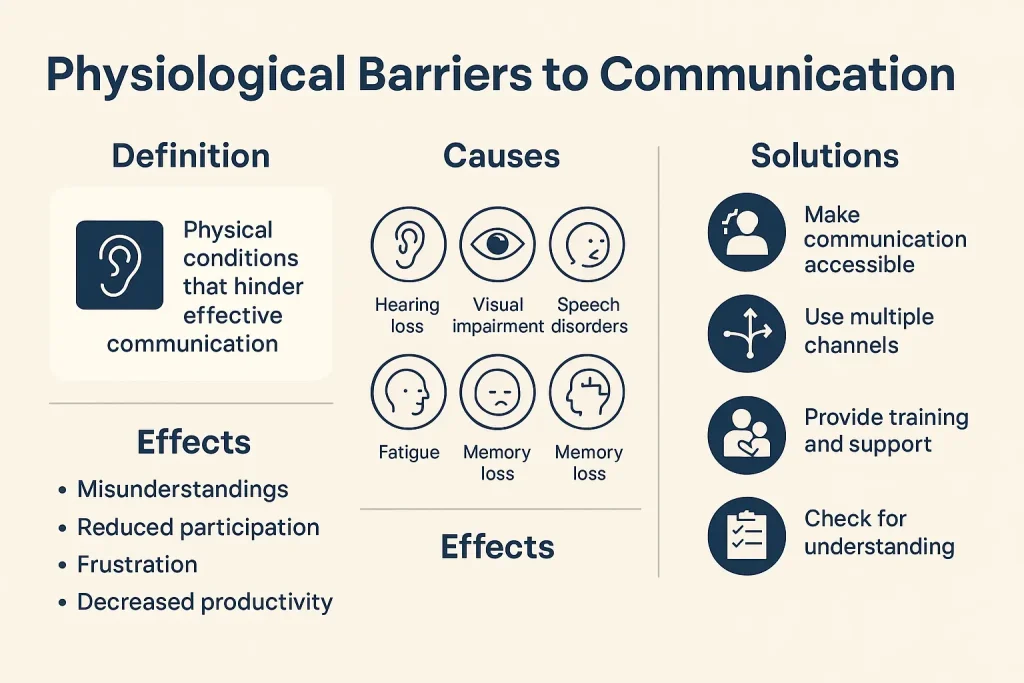
✔ Make Communication Accessible
- Use microphones or sound systems in meetings.
- Provide printed materials in large print or braille.
- Offer digital documents that work with screen readers.
✔ Encourage Breaks and Manage Workloads
- Schedule breaks during long meetings and shifts.
- Rotate tasks to prevent fatigue and burnout.
- Be understanding about medical appointments and rest periods.
✔ Use Multiple Communication Channels
- Back up verbal instructions with written notes, diagrams, or short videos.
- Allow asynchronous communication so people can respond at their own pace.
✔ Provide Training and Support
- Train staff to recognize and accommodate physiological needs.
- Offer access to assistive technology — hearing aids, magnifiers, speech apps.
- Foster a supportive, nonjudgmental culture.
✔ Check for Understanding
- Ask open-ended questions to confirm the message landed.
- Use the “teach-back” method — have people summarize what they heard in their own words.
How Can Individuals Overcome Physiological Barriers?
- Disclose your needs. Let colleagues or managers know about any physical challenges or preferences.
- Use assistive tools. Hearing aids, glasses, speech-to-text apps, and note-taking devices all help.
- Request accommodations. Ask for seating near the speaker, extra response time, or written copies of spoken information.
- Practice self-care. Prioritizing sleep, hydration, and stress management reduces temporary barriers like fatigue.
Temporary issues like exhaustion can also feed into emotional barriers to communication, since stress and tiredness chip away at patience and clarity.
Case Study: Overcoming Barriers in Healthcare
Picture a hospital ward where nurses and older patients keep talking past each other — instructions misheard, medication times confused, the same questions asked twice. The fix usually isn’t dramatic. Portable hearing amplifiers at the bedside, a simple staff habit of facing the patient and speaking clearly, and color-coded signage that doesn’t rely on small print can transform the experience. Interventions like these are well documented in healthcare communication research for reducing errors and improving patient confidence.
The lesson scales to any team: small, deliberate accommodations remove barriers faster — and far more cheaply — than expensive overhauls.
Why Is Addressing Physiological Barriers Important?
Leaving these barriers unaddressed carries real costs:
- Reduced safety — missed alarms or emergency instructions.
- Lower performance and morale.
- Exclusion and inequity in team participation.
- Legal exposure — inaccessible environments can violate disability laws.
Inclusive communication isn’t just considerate; it measurably boosts productivity, safety, and well-being for everyone involved.
Conclusion
Physiological barriers to communication are common, but they’re rarely permanent obstacles to connection. With awareness, the right accommodations, and a few practical tools, they can be managed effectively. Whether you’re a team leader, a healthcare provider, or simply someone who wants to communicate more clearly, addressing these challenges ensures that every voice can be heard fully — and it deepens your understanding of the broader types of communication barriers that shape how clearly any message gets through.


