
Barriers to Communication: Types, Examples & How to Overcome Them
Communication is the invisible thread that holds every team, family, and organization together. When it flows clearly, ideas move forward, trust grows, and people feel heard. When it breaks down, even the simplest task becomes harder — and the consequences can be serious.
Studies on workplace communication consistently show that miscommunication is one of the leading causes of project delays, employee disengagement, and lost productivity. In healthcare, poor communication is linked to medical errors and patient harm. In personal relationships, it quietly erodes trust over time.
The good news: every communication barrier can be identified, understood, and overcome.
What Are Barriers to Communication?
A barrier to communication is anything that prevents a message from being formed, delivered, received, or interpreted as the sender intended. Barriers don’t just create misunderstandings. They distort intent, erode trust, and quietly compound — small breakdowns become big problems weeks or months later.
For a complete map of every barrier covered on this site, see our types of communication barriers reference page.
Most articles list 10 or 15 barriers and stop there. The list is useful, but it doesn’t tell you which barrier is at play in a specific breakdown.
A more practical approach: every message has to pass through four filters before it lands. When communication fails, one of these filters is blocking it. Identify the filter, and the fix becomes obvious.
- Clarity — Was the message itself clear, well-formed, and complete?
- Channel — Was it sent through the right medium for its content and stakes?
- Receiver — Was the person on the other end in a state to take it in?
- Context — Did the environment (physical, cultural, organizational) let it through cleanly?
Every barrier covered below maps to one of these filters. When something goes wrong, walk through them in order. You’ll usually find the block within thirty seconds.
The 11 Main Types of Communication Barriers (With Examples)
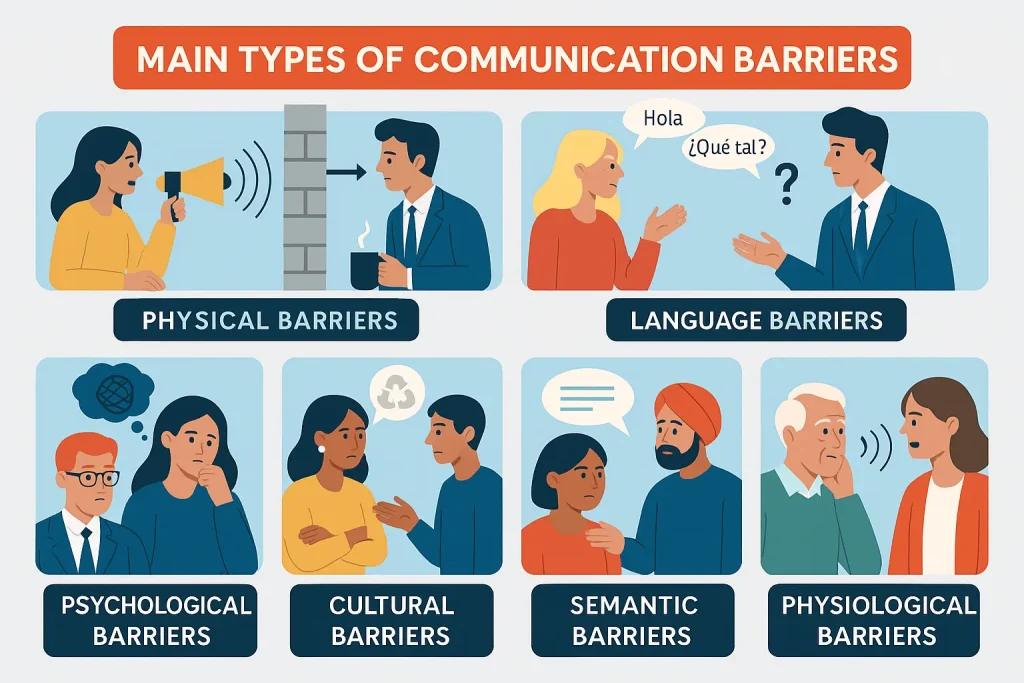
Below are the most common types of communication barriers, grouped by category, with examples and quick solutions for each.
Language and Semantic Barriers
These appear when sender and receiver don’t share vocabulary, fluency, or interpretation. A doctor saying “the lesion is benign but we’ll continue to monitor for metaplasia” to a patient who hears “lesion” and “monitor” and panics. A product manager dropping “table stakes” and “north star metric” in a meeting where half the room joined last week.
Fix: Write and speak for the least-informed person in the room. If you must use a technical term, define it the first time. Read your draft aloud — if you stumble, your reader will too.
For a deeper treatment, see our full guide on semantic barriers in communication.
Information Overload
The average knowledge worker now processes several hundred messages daily across email, Slack, Teams, and project tools. When everything is urgent, nothing is.
Fix: Lead every message with the conclusion, not the context. “I need approval on the vendor switch by Friday — here’s why” lands. “As you know, in Q2 we evaluated…” doesn’t.
Technological Barriers
A frozen video call. A two-paragraph performance concern delivered over Slack. A complex policy change buried in an email thread. The medium is part of the message.
Fix: Match channel to stakes. Routine updates go in writing. Sensitive, ambiguous, or emotional topics need voice or face-to-face. The general rule: if the message has feelings attached, hearing your tone matters more than reading your words.
Physical Barriers
Background noise, distance, faulty equipment, walls. The most common modern version is the muted-mic, frozen-video remote meeting where half the team has stopped trying to follow.
Fix: Test equipment before high-stakes calls. Use captions by default. For in-person work, designate at least one quiet space free from open-plan chatter.
See our complete guide on physical barriers to communication for accessibility-focused strategies.
Psychological Barriers
These are stable patterns: low confidence that prevents speaking up, distrust built from past negative experiences, anxiety that makes meetings feel like exams. They’re not moods; they’re operating defaults.
Fix: Build psychological safety before you need it. Teams that talk openly in calm moments handle the hard moments better. One concrete starter: in your next team meeting, ask each person to share one thing that’s blocking them, and resist the urge to immediately solve it.
Emotional Barriers
The in-the-moment cousin of psychological barriers. Anger, fear, grief, excitement — any strong emotion narrows the receiver’s bandwidth.
Fix: When you notice intense emotion (yours or theirs), pause the conversation. “I want to give this the attention it deserves. Can we pick this up at 2 PM?” is almost always better than pushing through. For a deeper look, see our guide on emotional barriers to communication.
Perceptual Barriers
Two people hear the same sentence and walk away with different meanings, because each is filtering through their own background, expectations, and confirmation bias. A manager says “we need to talk about your project,” and one employee hears curiosity, another hears doom.
Fix: Active listening with explicit checks. “What did you hear me say?” feels awkward the first few times. It’s also one of the highest-leverage habits in communication. More on perceptual barriers to communication.
Physiological Barriers
Hearing loss, vision impairment, speech difficulties, fatigue, illness, pain. Often overlooked because people don’t disclose them.
Fix: Build accessibility in by default — captions, written summaries after verbal meetings, larger fonts in shared documents, breaks during long sessions. The accommodations that help one person help everyone. See our full guide on physiological barriers to communication.
Attitudinal Barriers
Cynicism toward leadership. Resistance to change before understanding it. The mentally checked-out employee who skims every all-hands email.
Fix: Don’t argue with the attitude — address what created it. People rarely become cynical without reason. Ask, listen, and acknowledge before you try to persuade.
Cultural Barriers
Differences in directness, hierarchy, eye contact, silence, and gesture. A direct “that won’t work” from a Dutch colleague isn’t rude. A long pause from a Japanese colleague isn’t disagreement. A nod from an Indian colleague isn’t always agreement.
Fix: Default to curiosity. When something feels off, ask before assuming. For specific dynamics around gender barriers to communication — which interact heavily with culture — see the dedicated guide.
Organizational Barriers
InHierarchy, unclear reporting lines, bottlenecked information, too many filters between leaders and the front line. By the time a CEO’s message reaches the field, it’s a different message.
Fix: Reduce layers. Hold genuine all-hands Q&As, not scripted ones. Build anonymous feedback loops and act on them visibly — feedback systems collapse the moment people see input disappear into a void.
Why This Matters: Real-World Stakes
The cost of unaddressed barriers is concrete and measurable.
In healthcare: Communication failures during patient handoffs are well-documented contributors to medication errors and adverse events. See our deep dive on barriers to communication in nursing for shift-handoff protocols that meaningfully reduce risk.
In the workplace: Gallup’s long-running engagement research consistently shows that employees who feel uninformed by their managers are far more likely to be actively disengaged — and disengagement carries direct cost in productivity and turnover.
In education: Students who can’t ask for clarification fall behind quietly. The barrier isn’t intelligence; it’s whatever stopped the question.
In personal relationships: Most relationship conflicts are not about the surface topic. They’re about a pattern of not feeling heard. For more on this, see barriers to interpersonal communication.
The Diagnostic in Practice
When a communication breakdown happens, run it through the Four Filters in order.
Was my message clear? Could a stranger reading it know exactly what I want, by when, and why? If no, the problem started before it left you.
Was my channel right? Was this an email that should have been a call? A Slack message that should have been a meeting? Or a meeting that should have been an email?
Was my receiver ready? Was this person tired, distracted, defensive, or grieving? Were they coming off a hard meeting? Did I drop a complex ask into a five-minute window between their other commitments?
Was the context working with me or against me? Was the room loud? Was there a power dynamic that made disagreement risky? Was a cultural norm in play that I missed?
The filter that gives the clearest “no” is your barrier. Fix that one first.
Eight Strategies That Actually Work
1. Match the Channel to the Stakes
Performance feedback, conflict, bad news, and ambiguous topics belong in conversations where you can hear tone. Updates, instructions, and reference material belong in writing where they can be reread.
A practical heuristic: if a written message would take more than three paragraphs to land safely, it shouldn’t be a written message.
2. Lead with the Conclusion
The Bottom Line Up Front (BLUF) format used in military and intelligence writing exists because it works. Your reader’s attention is highest in the first sentence. Spend it.
Before: “I’ve been thinking about our Q3 hiring plan and after reviewing the budget projections…” After: “I want to delay the Q3 hire by one quarter. Here’s why.”
3. Practice Active Listening, Not Reactive Listening
Reactive listening is waiting for your turn to speak while assembling your response. Active listening is suspending your response until you’ve understood. The test is simple: can you accurately summarize what the other person said before you reply? If not, you weren’t listening.
4. Use the Teach-Back Method
Originally developed in healthcare to confirm patient understanding, teach-back works in any high-stakes communication. After explaining something complex, ask: “Just to make sure I explained that well — can you walk me through what you’ll do next?”
This frames the check as your responsibility, not theirs.
5. Build Two-Way Feedback Loops
One-way communication isn’t communication. It’s broadcasting. Real feedback systems share three traits: they’re easy to use, they’re anonymous when needed, and the people running them visibly act on what comes in.
6. Adapt for Cultural and Individual Context
Defaulting to your own communication norms with people who don’t share them is the most common mistake leaders make in diverse teams. Take fifteen minutes before any cross-cultural meeting to learn the basics: directness norms, attitudes toward hierarchy, how disagreement is signaled.
7. Watch for Information Overload — Including the One You’re Causing
If your team is buried in messages, audit your own contribution before complaining about theirs. Most overload is created by people who could have written shorter, sent fewer, or chosen a better channel.
8. Make Accessibility the Default, Not the Exception
Captions on every video. Written summaries after every verbal meeting. Materials shared in advance. Larger fonts in shared decks. None of these slow anyone down, and all of them help someone you don’t know needs help.
Practical Tools
The right tool doesn’t fix bad communication, but the wrong tool can prevent good communication from happening.
- Real-time collaboration: Slack, Microsoft Teams, Google Workspace
- Video with captions: Zoom, Google Meet, Microsoft Teams (verify captions are on by default for your team)
- Translation: DeepL (generally higher quality than Google Translate for nuanced text), Microsoft Translator
- Accessibility: Built-in screen readers (NVDA, JAWS, VoiceOver), Otter.ai for transcription, Microsoft’s Immersive Reader
- Anonymous feedback: Officevibe, CultureAmp, or a simple Google Form — what matters is the follow-up, not the platform
- Project clarity: Asana, Linear, Trello, Monday — pick one and commit; tool-switching kills team communication
Final Thoughts
Communication barriers aren’t a moral failing or a permanent condition. They’re patterns. Once you have a method for spotting them, you stop being surprised when they show up — and you start fixing them before they become expensive.
The best communicators aren’t the ones who avoid all barriers. They’re the ones who notice barriers fast, name them honestly, and adjust without ego.
If you found this useful, the deeper guides on each specific barrier are linked throughout — psychological, physical, emotional, cultural, gender, and more.