Emotional Barriers to Communication
A coworker sends you a one-line message: “Can we talk?” You reread it five times, hunting for the tone. By the time the meeting actually happens, you’ve already had three imaginary versions of the conversation — and none of them match what your coworker actually wanted to say.
That gap, between what was meant and what was felt, is where emotional barriers to communication live. They’re the internal feelings — fear, stress, mistrust, anger, low self-worth — that distort how we send and receive messages, even when the words themselves are perfectly clear.
Unlike physical distance or language gaps, emotional barriers are invisible. You won’t see them on an org chart or in a meeting transcript. But they’re behind most of the workplace conflicts that never quite resolve, the close relationships that quietly drift, and the feedback conversations that go sideways for no obvious reason.
This guide breaks down what emotional barriers actually are, how to recognize them in yourself and others, why they hit hardest at work and in close relationships, and the specific techniques — grounded in emotional intelligence research — that reliably reduce them. Emotional barriers are a key part of broader types of communication barriers that affect understanding at work, home, and in social interactions.
When emotions get in the way, even the clearest words can lose their meaning, and relationships—professional or personal—can suffer.
What Are Emotional Barriers to Communication?

Emotional barriers to communication are internal feelings or emotional states that interfere with the effective exchange of ideas and information. These barriers often arise from anxiety, fear, mistrust, anger, or even over-excitement.
They fall under psychological barriers to communication, as they operate internally and affect how messages are perceived and interpreted.
Unlike physical or environmental obstacles, emotional barriers are invisible—but their impact can be just as powerful.
Why Do Emotional Barriers Occur?
Emotional barriers develop for many reasons:
- Past experiences – Hurtful events reduce openness
- Low self-esteem – Doubting oneself limits expression
- Fear of judgment – Leads to silence or dishonesty
- Stress and anxiety – Reduces listening and clarity
- Strong emotions – Distort tone and meaning
These barriers can be temporary or deeply rooted, often overlapping with interpersonal communication barriers, especially in close relationships.
Why Are Emotional Barriers Important to Recognize?
Recognizing emotional barriers matters because they:
- Distort messages through selective listening
- Damage trust and emotional safety
- Reduce productivity in professional environments
- Increase stress and mental strain
In workplaces, emotional barriers frequently contribute to communication barriers in the workplace, where misunderstandings escalate into conflict.
How Do Emotional Barriers Affect Communication?
Emotional barriers can lead to:
- Misunderstandings
- Low morale
- Reduced collaboration
- Damaged relationships
- Escalating conflict
According to a 2023 report by the American Psychological Association, organizations that address emotional well-being experience higher employee satisfaction and lower turnover—showing the real impact of emotional communication blocks.
How Can You Identify Emotional Barriers?
Common warning signs include:
- Withdrawal from discussions
- Defensive or short responses
- Reluctance to give feedback
- Tension or discomfort in conversations
- Repeated misunderstandings
These signs often appear alongside language barriers to communication, where emotional stress further distorts meaning.
What Are the Main Causes of Emotional Barriers?
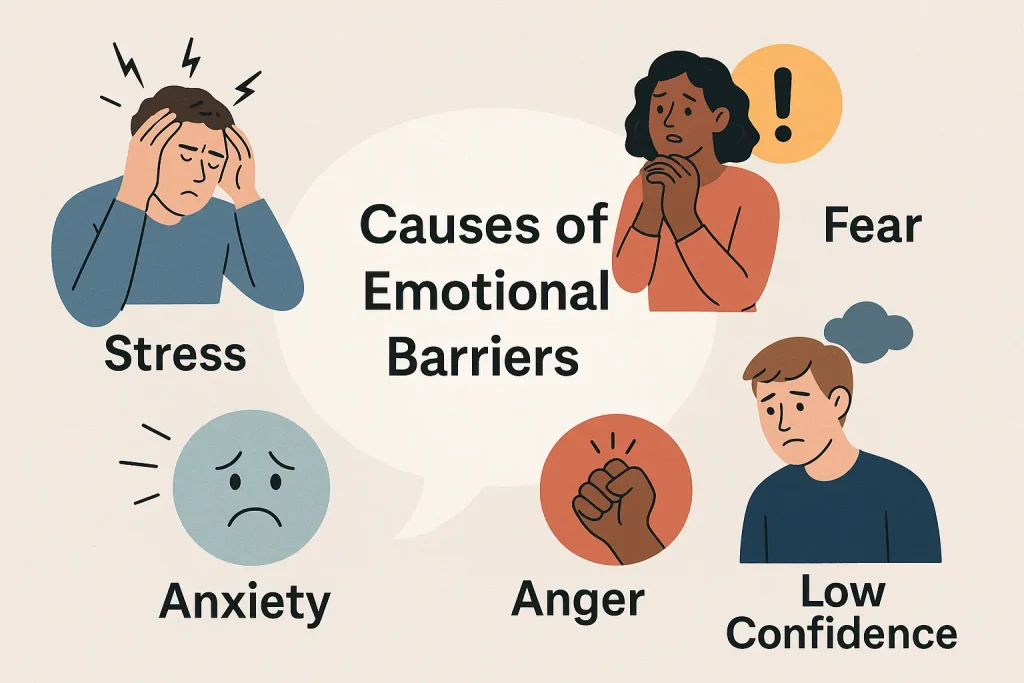
Emotional barriers are rarely random. They usually come from specific causes:
- Fear of Judgment or Criticism – People may hold back opinions if they expect rejection.
- Low Confidence – Lack of self-esteem often leads to hesitation in speaking up.
- Stress and Anxiety – High stress makes it harder to focus on communication.
- Anger or Resentment – Strong negative emotions distort tone and perception.
- Cultural or Personal Sensitivities – Some individuals may feel offended more easily due to past experiences.
- Past Negative Experiences – Previous conflicts or trauma create defensive communication patterns.
What Are Common Examples of Emotional Barriers?
- Defensiveness in feedback – Criticism feels like a personal attack
- Avoidance in conflict – Fear prevents discussion
- Mistrust in teams – Neutral remarks feel hostile
- Emotional overload – Stress blocks listening
Such patterns are common in workplaces with unresolved organisational barriers to communication, where hierarchy or culture discourages openness.
How Do Emotional Barriers Affect Workplace Communication?
Emotional barriers in the workplace are expensive, and most of the cost is invisible until it shows up as turnover, missed deadlines, or a project that quietly stalls. Five patterns drive most of the damage:
Tone misreading in written channels
Email and Slack strip out the majority of communication cues — facial expression, vocal inflection, posture, pacing. A neutral message like “Can we talk?” gets read through whatever the recipient is already feeling. Anxious employees see threats. Frustrated managers see attitude. Both are responding to a message that was never actually sent.
Meeting silence that isn’t agreement
When people don’t speak up, leaders often interpret it as alignment. More often, it’s emotional withdrawal — fear of looking unprepared, of contradicting a senior voice, or of being singled out later. The decision moves forward, the real concerns surface weeks later, and the project pays for it.
Feedback that lands as attack
A manager gives precise, well-intentioned feedback. The employee hears criticism of their character. The manager then avoids giving feedback at all, reasoning that the person “can’t take it.” Performance stagnates on both sides — and neither has technically done anything wrong. The emotional channel between them is just blocked.
Conflict escalation through assumed intent
Two team members disagree on an approach. Without emotional safety, the disagreement becomes “they don’t respect my work.” Now it’s personal, and the original technical question is unsolvable until the relationship is repaired.
Hidden disengagement
The most damaging form because it doesn’t look like a problem. Employees stay polite, hit basic targets, and stop contributing ideas. Innovation drops first; retention drops six to twelve months later.
Workplaces that address these patterns — through psychological safety practices, clear feedback frameworks, and leaders who model vulnerability themselves — typically see faster decision-making, higher engagement, and lower turnover. The investment is small. The cost of ignoring it is rarely measured but reliably large.
These challenges are compounded when cultural expectations differ, linking emotional barriers with cultural barriers to communication.
How Do Emotional Barriers Affect Personal Relationships?
Emotional barriers often do more damage in personal relationships than in any professional setting, because the stakes feel higher and the history runs deeper. A single defensive reaction between partners, parents, or close friends can shut down a conversation that’s been quietly building for weeks.
In romantic relationships, emotional barriers usually surface as misread intent. One partner withdraws after a hard day; the other reads silence as rejection. Resentment accumulates because neither person says what they actually feel — they react to what they assume the other meant. Research on long-term couples consistently identifies perceived emotional safety, not the absence of conflict, as the strongest predictor of relationship satisfaction.
Between parents and children, the imbalance of authority complicates honest exchange. Children may suppress fears or frustrations to avoid disappointing a parent, while parents sometimes confuse compliance with understanding. Over time, this builds a wall that becomes harder to dismantle as the child grows older and the unspoken topics multiply.
Friendships are often the first to suffer in silence. Difficult conversations get postponed because no one wants to risk the friendship — and that avoidance is exactly what hollows it out.
A few patterns to watch for in any close relationship:
- Mind-reading — assuming you know what the other person feels without asking
- Stonewalling — going silent during conflict instead of pausing and returning
- Score-keeping — pulling old hurts into unrelated arguments
- Performative agreement — saying “I’m fine” when you aren’t
The unifying issue is the same as in workplaces: when emotions go unspoken, they don’t disappear. They distort the next conversation, and the one after that, until the original feeling is buried under months of small avoidances.
Can Emotional Barriers Ever Be Helpful?
Yes — but only briefly, and only when used deliberately.
Some emotional friction works as a useful pause button. The split-second hesitation before you fire off an angry email, the discomfort that stops you from oversharing with a near-stranger, the social caution that keeps a heated meeting from escalating — these are moments where emotion is doing protective work.
Healthy uses of emotional caution include:
- Buffer time before reacting, so the response is considered rather than impulsive
- Discretion in unsafe environments — not every workplace or family system rewards full openness, and reading the room is a skill
- Self-protection during processing — sometimes you genuinely don’t have the bandwidth to discuss something, and saying “I want to talk about this, but not tonight” is healthier than forcing it
The line between helpful and harmful is whether the barrier is temporary and chosen, or persistent and reflexive. A one-time pause is emotional regulation. A permanent inability to raise a topic is avoidance — and avoidance compounds. If the same conversation has been “not the right time” for six months, the barrier has stopped protecting you and started costing you.
The goal isn’t to eliminate emotional caution. It’s to make it conscious instead of automatic.
How Do You Tell Emotional Barriers Apart From Other Communication Issues?
Not every breakdown in conversation is emotional. Misreading the source of a problem is one of the fastest ways to make it worse — applying empathy to a structural issue, or process fixes to a fear-based one, leaves both unsolved.
Use this quick diagnostic:
- The same person is clear with some people and shut down with others → likely emotional. The skill exists; safety doesn’t.
- Everyone struggles with the same channel or tool → likely organizational or technical. Fix the system, not the people.
- Misunderstandings cluster around specific words, idioms, or accents → likely a language or cultural barrier.
- Clarity drops sharply when stress spikes (deadlines, feedback, conflict) → emotional barriers are stacking on top of other issues.
- Feedback flows down but never up → likely hierarchical, even if individual conversations feel emotional.
The clearest signature of an emotional barrier is inconsistency. Someone who can articulate a complex idea in one room but goes quiet in another isn’t short on skill — they’re reading the emotional temperature differently. That’s the tell.
Once you’ve diagnosed correctly, the fix follows: structural problems need policy changes, language gaps need translation or plain wording, and emotional barriers need safety — not better arguments.
Strategies to Overcome Emotional Barriers
Here are practical steps for individuals and organizations:

✔ Practice active listening
✔ Foster a safe, open environment
✔ Build emotional intelligence
✔ Encourage self-reflection
✔ Provide emotional support
✔ Deliver feedback thoughtfully
Strong emotional intelligence improves conflict resolution and complements efforts to reduce interpersonal communication barriers.
What Role Does Emotional Intelligence Play?
Emotional intelligence is the ability to recognize, understand, and manage your emotions while responding effectively to others’ emotions.
High EI communicators can:
- Stay calm under pressure.
- Empathize with others’ feelings.
- Deliver feedback without triggering defensiveness.
Organizations that invest in EI development see better teamwork and leadership outcomes. For personal life, EI strengthens empathy and conflict resolution.
Practical Tips to Reduce Emotional Barriers
- Use “I” Statements: Say “I feel concerned” instead of “You always ignore me.”
- Take a Pause: Delay responding when emotions are high.
- Check Non-Verbal Cues: Body language often carries emotional weight.
- Provide Constructive Feedback: Frame criticism as guidance, not attack.
- Encourage Support Systems: Mentorship, counseling, or HR initiatives can help in workplaces.
Emotional vs Other Communication Barriers
| Barrier Type | Root Cause | How It Shows Up | What Tends to Fix It |
|---|---|---|---|
| Emotional | Fear, stress, anger, mistrust, low self-esteem | Defensiveness, withdrawal, misread tone, avoidance | Psychological safety, emotional intelligence, active listening |
| Language | Vocabulary gaps, jargon, fluency differences | Literal misunderstandings, wrong translations, asking the wrong question | Plain language, glossaries, paraphrasing back |
| Cultural | Differing norms around hierarchy, directness, time, eye contact | Behavior misread as rude or evasive when it’s culturally appropriate | Cultural awareness, asking before assuming |
| Organizational | Hierarchy, silos, unclear channels | Information stuck at one level, blocked upward feedback, duplicated work | Flatter structures, anonymous feedback, clear ownership |
| Physical / Environmental | Noise, distance, poor tools, distractions | Missed messages, fatigue, low-quality calls | Better tools, dedicated quiet space, hybrid norms |
| Perceptual | Bias, assumptions, selective listening | Hearing what you expect rather than what was said | Slowing down, paraphrasing, checking assumptions |
These barriers rarely appear in isolation. A stressed employee (emotional) working remotely (physical) inside a strict hierarchy (organizational) with international colleagues (cultural and language) is dealing with all five at once.
The reason emotional barriers get so much attention is that they amplify every other type. A calm, secure communicator can usually navigate language or cultural differences with patience; an anxious one struggles even when everyone speaks the same language and shares the same culture. That’s why investing in emotional intelligence tends to pay off across every other category of communication challenge — it’s the closest thing to a general-purpose fix.
Why Is It Important to Address Emotional Barriers?
Tackling emotional barriers is essential for healthy relationships, strong teams, and effective problem-solving. When people feel safe to express themselves, creativity flourishes, conflicts resolve more quickly, and everyone feels respected. Ignoring these barriers, on the other hand, only allows small issues to grow into bigger problems.
Conclusion
Emotional barriers to communication are invisible, but their effects are real. Fear, stress, mistrust, and unmanaged emotions quietly disrupt understanding, relationships, and collaboration.
By recognizing how emotional barriers connect with psychological, workplace, language, and cultural communication barriers, individuals and organizations can build safer, clearer, and more effective communication environments.


