
Organisational barriers to communication
Organizational barriers to communication are the structural, cultural, hierarchical, and linguistic obstacles built into how a company is designed and run that stop information from flowing clearly between people and teams. Unlike a single misunderstanding between two colleagues, these barriers are systemic — they’re baked into the org chart, the approval process, the office layout, and the unwritten rules about who gets to speak up. And because they’re systemic, they affect every decision the organization makes.
The cost is real and measurable. When communication is blocked, decisions slow down, errors multiply, good ideas never surface, and the most capable employees quietly disengage. This guide breaks down the four main types of organizational communication barriers, explains how they damage performance, and lays out the strategies that actually fix them.
Why Organizational Barriers to Communication Matter
The clearest way to understand the stakes is to look at what good communication is worth. McKinsey Global Institute estimated that improving collaboration and communication within and across companies could raise the productivity of knowledge workers by 20 to 25 percent — driven largely by the time these workers currently lose to inefficient information-sharing. The same research found the average knowledge worker spends roughly 28% of the workweek just managing email and nearly another 20% hunting for internal information.
That lost time is the visible tip of the problem. Beneath it sit the compounding effects:
- Slower, lower-quality decisions. When information is filtered, delayed, or distorted on its way to decision-makers, choices get made on incomplete or outdated facts.
- Costly errors and rework. Vague instructions and broken handoffs mean work gets done wrong and then redone — a direct hit to both cost and morale.
- Stifled innovation. When employees don’t feel safe sharing ideas, or when ideas can’t travel across departmental walls, the organization stops learning from itself.
- Disengagement and turnover. People who feel unheard leave — and the most talented, most mobile employees leave first. Replacing them is expensive and disruptive.
The throughline is that organizational barriers don’t announce themselves with a single dramatic failure. They tax the entire system quietly, every day, until the cumulative cost becomes a competitive disadvantage.
Types of Organisational Barriers
Communication in organizations can be blocked by many factors connected to how the company is set up and run. These obstacles include how tasks and roles are arranged, differences in workplace culture, the layers of management, and problems with language or meaning.
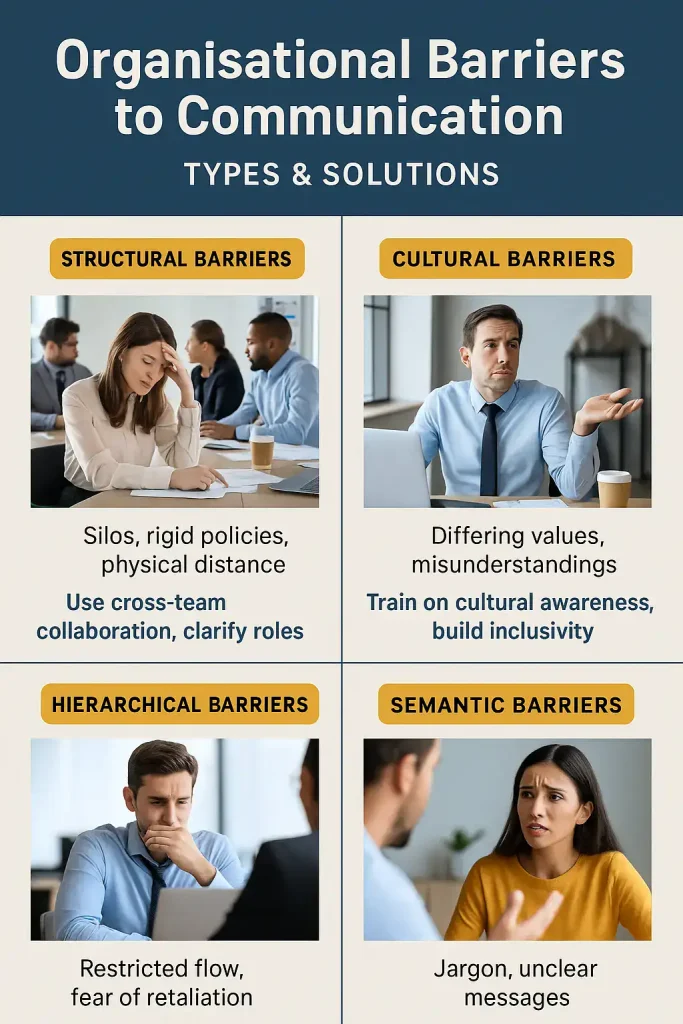
Organizational barriers fall into four broad categories. In practice they overlap and reinforce one another — a rigid hierarchy often creates cultural fear, which then compounds language and structural problems — but understanding each one individually is the first step to addressing them.
Structural Barriers
Structural barriers come from how the organization itself is designed — its departments, workflows, reporting lines, and physical or digital architecture.
The most common is the silo: departments that operate as self-contained units with little incentive or mechanism to communicate across boundaries. Marketing doesn’t know what product is building; sales doesn’t know what support is hearing from customers. Each team optimizes for itself while the organization as a whole loses the connective information that would make it smarter.
Approval bottlenecks are another structural failure. When every message or decision must pass through multiple layers of sign-off, two things happen: decisions slow to a crawl, and the message itself gets distorted as each layer reinterprets it — a corporate game of telephone.
Physical and digital separation adds friction too. Remote and hybrid teams, multiple office locations, and time-zone gaps all reduce the spontaneous, informal communication that holds teams together — unless the organization deliberately replaces it with well-designed digital channels.
What it looks like: a customer complaint that three departments each see a piece of but no one connects; a project stalled for a week waiting on a signature; a remote team that finds out about a major change days after the head office.
Cultural Barriers
Workplace culture determines the unspoken rules of communication: how directly people are expected to speak, how feedback is given and received, whether disagreement is welcomed or punished, and how authority is treated.
In multinational organizations, these differences multiply. In some cultures, employees are expected to challenge ideas openly in meetings; in others, public disagreement with a senior colleague is deeply inappropriate. A manager who interprets respectful silence as agreement — or as disengagement — is misreading a cultural signal, not a personal one. Nonverbal norms differ just as widely, from eye contact to physical proximity to how punctuality is treated.
But cultural barriers aren’t only international. Every company has a culture, and a culture of fear, blame, or rigid formality blocks honest communication just as effectively as any language gap.
What it looks like: a global team where the head-office staff dominate every meeting because regional colleagues’ communication norms are quieter; a workplace where no one delivers bad news upward because the last person who did was blamed for it.
Hierarchical Barriers
Information behaves differently as it moves up and down a chain of command — and rarely for the better.
Moving upward, information gets filtered. Employees soften, omit, or delay bad news because they fear how it will reflect on them. By the time a problem reaches senior leadership, it has often been sanitized into something that no longer signals urgency — a phenomenon sometimes called the “mum effect.”
Moving downward, information gets compressed and stripped of context. Decisions arrive as directives without the reasoning behind them, leaving employees to execute instructions they don’t fully understand and can’t meaningfully question.
The deeper cost is what doesn’t get said at all. In steep hierarchies, junior employees self-censor — they hold back concerns, observations, and ideas because the perceived risk of speaking up outweighs the reward. The organization loses exactly the frontline insight it most needs.
What it looks like: a leadership team genuinely surprised by a problem that half the floor saw coming; a new hire who spots an obvious flaw in a plan but says nothing because “that’s not my place.”
Language and Semantic Barriers
Language barriers are obvious when colleagues speak different native languages — but semantic barriers, where the same words carry different meanings to different people, are subtler and often more damaging because no one realizes a misunderstanding has occurred.
Jargon is a frequent culprit. Technical teams, finance, legal, and marketing each develop their own vocabulary, and a term that’s precise inside one department is opaque or means something different in another. “Done,” “soon,” “high priority,” and “final version” are interpreted wildly differently across people and teams.
Vague instructions compound the problem. “Can you take a look at this when you get a chance?” communicates almost nothing actionable — not the deadline, not the depth of review expected, not the priority relative to other work.
What it looks like: two teams confidently working toward different definitions of the same goal; a project delivered “on time” by one person’s definition and late by another’s; an instruction interpreted as optional when it was meant as urgent.
How Do Organisational Barriers Affect Business Performance?
The effects of these barriers aren’t abstract — they show up directly on the bottom line and in the day-to-day experience of working there.
Productivity erodes as employees waste time clarifying unclear messages, searching for information that should be easy to find, and redoing work that was based on a misunderstanding. This is where the McKinsey 20–25% figure comes from: it’s not that better communication adds new capacity, but that poor communication wastes the capacity already there.
Decision quality drops because leaders act on filtered, delayed, or distorted information. A decision is only as good as the information behind it, and organizational barriers degrade that information at every handoff.
Innovation stalls when ideas can’t travel — across departmental silos, up through hierarchical filters, or past a culture that punishes the risk of speaking up. Organizations that can’t move information internally can’t learn from themselves.
Talent walks out the door. Disengagement caused by feeling unheard is one of the most consistent predictors of turnover, and turnover is among the most expensive problems any organization faces — in recruitment cost, lost institutional knowledge, and the productivity dip while a replacement gets up to speed.
The pattern is consistent: organizational barriers convert the company’s existing talent and effort into waste, and they do it quietly enough that the cost is often invisible until it’s measured.
How Do Organisational Barriers Affect Productivity?
They cause:
- Delays in decision-making
- Reduced morale
- Loss of efficiency
- Lower innovation
According to McKinsey, companies with effective communication are significantly more likely to outperform competitors in productivity and engagement.
How to Overcome Organizational Barriers to Communication
Fixing organizational barriers requires changing the system, not just coaching individuals. The most effective approaches work on structure, culture, and process together.
Build psychological safety deliberately
The single highest-leverage change is making it genuinely safe to speak up. This is not a poster on the wall — it’s how leaders respond the first time someone delivers bad news or challenges a decision. If that person is thanked rather than punished, the message travels fast. If they’re blamed, every other employee learns to stay silent. Leaders set this tone with their reactions far more than their words.
Flatten and clarify where you can
Reduce unnecessary layers of approval and ambiguous reporting lines. Every layer a message must pass through is an opportunity for delay and distortion. Where hierarchy is necessary, make the reasoning behind decisions travel downward alongside the decisions themselves — context turns directives into something people can execute intelligently.
Break silos with structural connection, not just encouragement
Telling departments to “collaborate more” rarely works. Building actual mechanisms does: cross-functional teams, shared project channels, regular interdepartmental syncs, and shared metrics that reward teams for outcomes only achievable together. Structure beats exhortation.
Standardize the language of important communication
Create shared definitions for ambiguous but high-stakes terms (what does “priority” actually mean here? what does “done” require?). For critical or upward communication, structured formats reduce both ambiguity and the hesitation that hierarchy creates. Encourage the habit of confirming understanding rather than assuming it.
Invest in communication tools — and in using them well
Reliable, well-implemented digital tools are essential, especially for remote and hybrid teams. But the tool is only half the solution: poorly chosen or poorly adopted technology adds friction rather than removing it. Pair any tool investment with training and clear norms for which channel is used for what.
Train leaders specifically
Managers are the chokepoints through which most organizational communication flows. Communication training focused on listening, giving and receiving feedback, and preventing information bottlenecks pays off disproportionately at the leadership level, because a single manager’s habits shape an entire team’s information flow.
Measure, then adjust
Use pulse surveys, feedback channels, and reviews of where decisions or projects stalled to locate the specific points where communication keeps breaking. Treat organizational communication as something you monitor and improve continuously, not a problem you solve once.
Conclusion
Organizational barriers to communication are an inevitable feature of any complex workplace — but they are not a permanent ceiling on performance. Once you can recognize them by type — structural, cultural, hierarchical, and linguistic — they become addressable problems rather than vague frustrations. The organizations that handle them best treat communication as infrastructure: something to be deliberately designed, actively maintained, and continuously improved. The payoff is substantial. Clearer communication doesn’t just reduce friction — it unlocks the productivity, innovation, and engagement the organization already has but is currently wasting.


