Barriers to Classroom Communication
Walk into any classroom — a bustling city school, a quiet rural one, an online session with cameras off — and you’ll find the same invisible problem: communication breaking down before it ever starts. A student who doesn’t understand the question stays silent. A teacher who can’t reach a shy learner assumes disinterest. A lesson delivered in clear English lands in confusion for the student still learning the language.
Barriers to classroom communication are any physical, emotional, cultural, linguistic, or organizational factors that prevent clear understanding between teachers and students, or among students themselves. They don’t announce themselves. They show up quietly — in blank faces, unanswered questions, and the students who slowly disengage.
These classroom challenges are part of the broader types of communication barriers that affect understanding in different settings.
What Are the Main Types of Barriers to Classroom Communication?
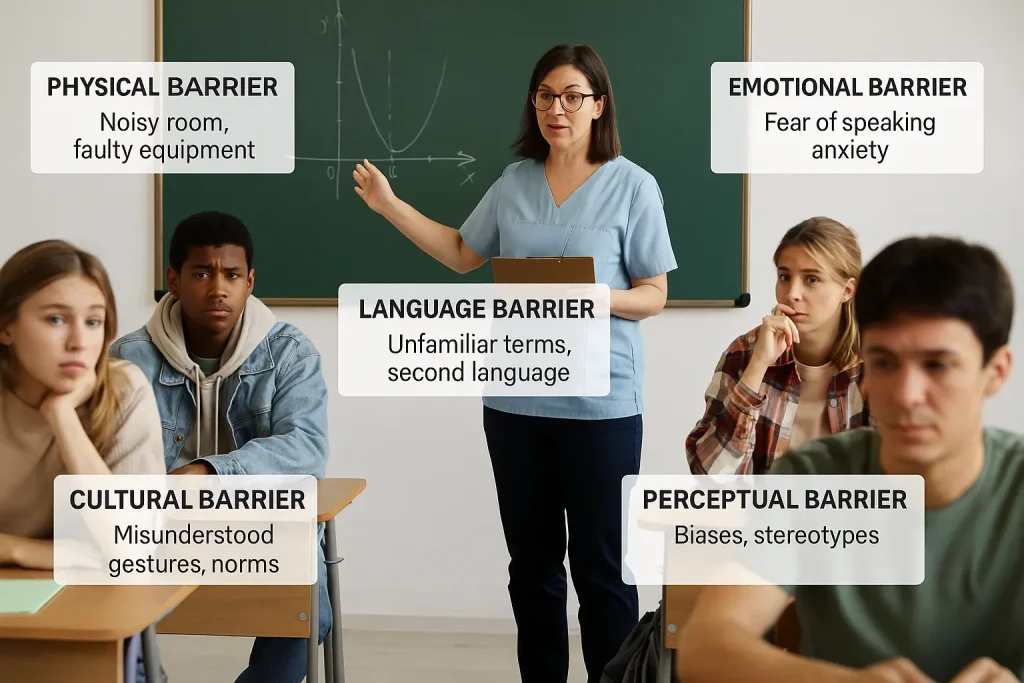
Barriers to classroom communication can take many forms. The most common types include:

Physical Barriers
The environment a student learns in shapes how much they retain. Large class sizes mean less one-to-one attention. Poor acoustics make it physically hard to follow a lesson. Faulty microphones, projectors that flicker, or seats at the back of a 40-person room all create the same result: students receive an incomplete message and fill in the gaps with guesswork.
These barriers are especially damaging because they’re invisible to the teacher at the front. A student who mishears an instruction won’t always say so — they’ll attempt the task incorrectly and wonder why they got it wrong.
Common classroom examples: background noise from hallways, crowded seating, broken or missing assistive technology, poor room lighting.
Language and Semantic Barriers
In multilingual classrooms, language is the most obvious barrier — but it’s rarely the only one. A student who is still developing fluency in English may understand the concept perfectly but lack the vocabulary to demonstrate it. Subject-specific terminology creates a second layer of confusion: words like osmosis, denominator, or protagonist can disorient even native speakers encountering them for the first time.
The risk is that teachers interpret silence or wrong answers as a lack of understanding, when the real issue is a language gap — not a knowledge gap.
Common classroom examples: ESL learners struggling to follow fast-paced instructions, jargon-heavy explanations without context, idioms misread literally.
Emotional and Psychological Barriers
Emotions are among the most powerful filters in any classroom. A student afraid of being laughed at won’t raise their hand, even when they know the answer. One who has been criticized harshly in the past will shut down before attempting a task. Anxiety — particularly math anxiety or performance anxiety during presentations — can make information processing nearly impossible in the moment.
These barriers are often mislabeled as behavioral problems or lack of motivation, which leads to the wrong interventions and deepens the original problem.
Common classroom examples: fear of public speaking or reading aloud, low self-confidence in a second language, past academic trauma, test anxiety that blanks out known information.
Cultural Barriers
Culture determines not just what students say but how and whether they say it at all. In some cultures, questioning a teacher is considered disrespectful; in others, direct eye contact signals confidence; in still others, it signals confrontation. A student who sits quietly and listens intently may be showing deep respect — but be misread as unengaged.
These misreads travel in both directions. Teachers from one cultural background may unknowingly use humor, examples, or body language that confuses or alienates students from another.
Common classroom examples: differing norms around debate and disagreement, silence interpreted as passive rather than respectful, holiday or cultural references that exclude students from minority backgrounds.
Perceptual Barriers
Every teacher and student brings assumptions into the classroom. A teacher who expects a struggling student to underperform may give that student less opportunity to contribute — and the student, sensing the low expectation, confirms it. A student who decides early that a subject is “not for them” filters out instruction and stops engaging.
These biases are rarely conscious, but they consistently shape who gets called on, who receives encouragement, and who slips through unnoticed.
Common classroom examples: gendered assumptions about ability in science or arts subjects, bias based on a student’s older sibling’s reputation, students writing off a subject after a single bad result.
Organizational Barriers
Even the most skilled communicator is limited by the system they work within. Rigid timetables that leave no time for questions, class sizes too large for meaningful discussion, a lack of support staff for students with additional needs — these are structural barriers that no individual teacher can solve alone.
When policies don’t account for diverse learning needs, communication fails not because of what anyone says but because of how the environment is designed.
Common classroom examples: 60-minute lessons with no check-in time built in, no interpreter or learning-support availability, curriculum materials available only in English.
Physiological Barriers
Hearing loss, visual impairment, speech and language disorders, dyslexia, and ADHD all affect how students send and receive messages in class. These are not choices or behaviors — they are neurological or physical realities that require specific adaptations.
When a classroom isn’t designed with these needs in mind, students who rely on lip-reading miss content the moment a teacher turns toward the board. Students with auditory processing disorders may hear every word but struggle to sequence and retain them.
Common classroom examples: a hearing-impaired student missing verbal instructions, a dyslexic student unable to follow dense written materials, an ADHD student losing a spoken instruction halfway through it.
| Barrier Type | What It Looks Like in the Classroom | Why It Matters | Practical Starting Point |
|---|---|---|---|
| Physical | Noisy room, broken equipment, overcrowded seating | Students receive incomplete messages and guess | Seat students by need; fix or report broken tools immediately |
| Language | ESL learners, subject jargon, idiomatic instructions | Correct answers get buried beneath the wrong words | Use plain language, visual aids, and vocabulary pre-teaching |
| Emotional | Silence from fear, avoidance, shutting down under pressure | Anxiety blocks information processing entirely | Build psychological safety before expecting participation |
| Cultural | Quiet deference misread as disengagement | Teachers and students misinterpret each other’s intent | Ask, don’t assume; use culturally diverse examples |
| Perceptual | Low expectations, assumptions based on past performance | Self-fulfilling cycles of underachievement | Reflect on who you call on and who you overlook |
| Organizational | No time for questions, oversized classes, missing support staff | Good teaching is undermined by poor structure | Advocate for adequate resources; flag structural gaps formally |
| Physiological | Hearing/vision impairment, dyslexia, ADHD | Real barriers get misread as behavioral problems | Use subtitles, large print, multisensory delivery, and aides |
How Do Barriers to Classroom Communication Affect Learning?
Barriers to classroom communication can have significant negative effects on student learning, participation, and well-being. Here’s how:
The short answer: in every direction at once. Barriers don’t just slow learning — they reshape who participates, who disengages, and which students fall silently behind.
Comprehension drops first
When a student misses a key instruction or doesn’t understand a term, everything that follows in the lesson is built on unstable ground. The gap isn’t just that day’s material — it’s the foundation for whatever comes next.
Participation narrows
In most classrooms, it’s the same students who speak, answer, and ask. Communication barriers explain a significant part of why: emotional barriers silence the anxious student, cultural norms silence the respectful one, and low expectations silence the student who has already decided they don’t belong in the conversation.
Confidence erodes quietly
A student who misunderstands and gets a question wrong — not because they lack ability but because the message didn’t land clearly — doesn’t always identify the real cause. They frequently conclude that they’re not smart enough, rather than that the communication failed. Over time, this shapes their entire relationship with learning.
Behavioral problems surface
Frustration, boredom, and anxiety all look like behavior when they’re really communication failures in disguise. Students who act out in class are disproportionately students whose needs aren’t being communicated — or heard.
Learning gaps compound
The students most affected by communication barriers are usually those already navigating disadvantage: language learners, students with learning differences, students from cultural minorities. Unaddressed barriers widen existing inequalities rather than closing them.
In some cases, unresolved barriers can resemble challenges seen in barriers to communication in healthcare, where misunderstanding can lead to serious consequences.
How Can Teachers Overcome Barriers to Classroom Communication?
The most effective teachers don’t just communicate well — they design their classrooms to reduce failure points before a lesson begins. Here are the strategies that make the most consistent difference.
Start by diagnosing the barrier, not the student
Before labeling a student as disengaged, unmotivated, or difficult, ask which barrier type is most likely in play. Silence from a cultural background that values deference requires a different response than silence from anxiety — and both are different from a student who simply didn’t hear the instruction.
Use multiple formats for every key messag
The same instruction delivered verbally, written on the board, and shown as a simple visual reaches students whose barriers are linguistic, attentional, or physiological. This isn’t about over-explaining — it’s about redundancy by design.
Build psychological safety before academic challenge
Students won’t ask questions in a climate where they fear being laughed at. A simple norm — “there are no stupid questions here” followed by genuinely non-judgmental responses when it’s tested — does more than any curriculum change. Teachers who consistently model curiosity and tolerate wrong answers on the way to right ones build classrooms where communication actually flows.
Practice structured inclusion
Rather than defaulting to “who wants to answer?”, use techniques like think-pair-share, written responses before discussion, or cold-calling with advance warning (“I’ll ask you about this in two minutes — take a moment to think”). These formats give quieter students processing time and remove the pressure of spontaneous public performance.
Check for understanding explicitly
Asking “does everyone understand?” gets a room full of nodding heads regardless of actual comprehension. More reliable methods: ask a student to explain the task back to you in their own words, use quick written exit slips, or use anonymous digital polling where students can flag confusion without public embarrassment.
Advocate for structural solutions
Some barriers — class size, lack of interpreters, absent support staff — are beyond any single teacher’s power to fix. Document these gaps, raise them formally, and connect them to specific student outcomes. Individual adaptations matter, but systemic change requires evidence.
Conclusion
Barriers to classroom communication are real, but they do not have to be permanent. By recognizing how these challenges connect with broader communication barriers—whether psychological, cultural, or organizational—schools can build more inclusive and effective learning environments.
When communication improves, participation rises, relationships strengthen, and every student has a better chance to succeed.


